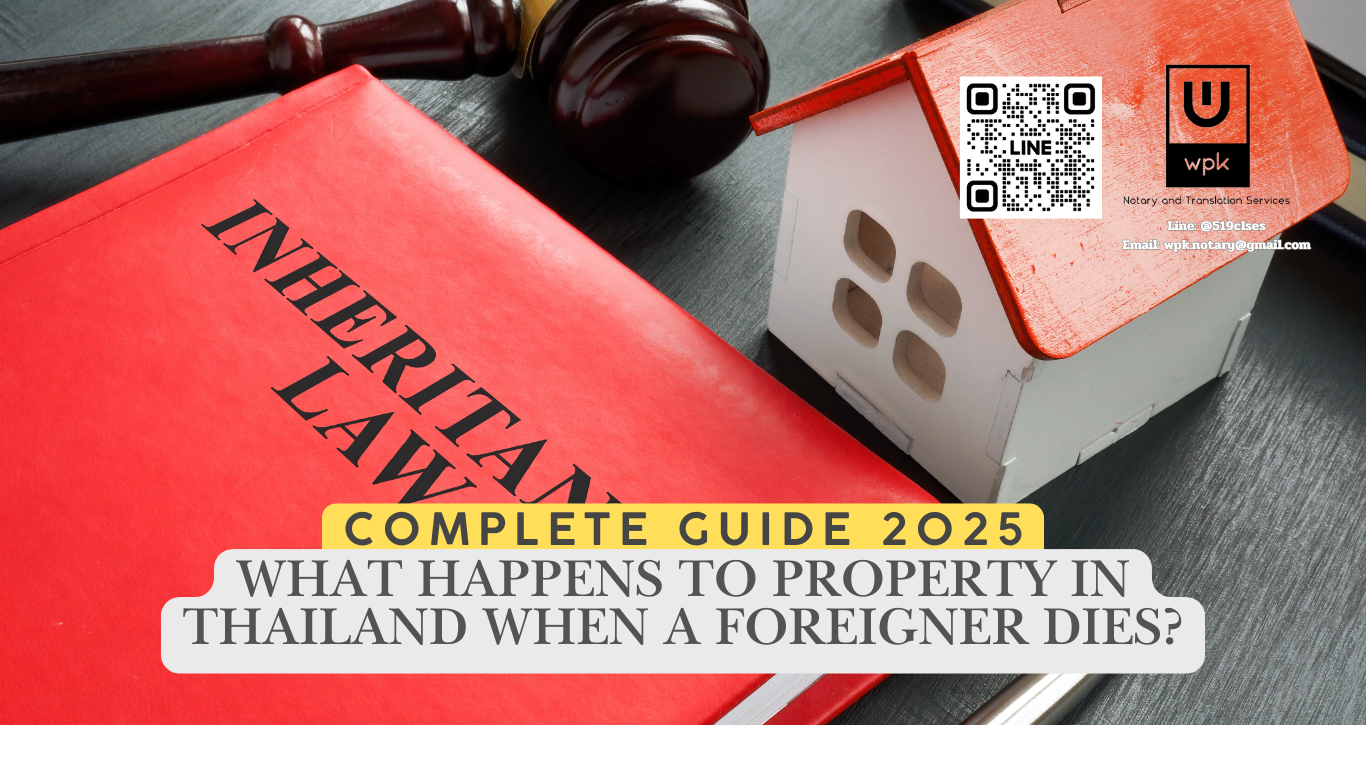
When a foreigner passes away while living in Thailand or owns property in Thailand, family members often wonder what happens next. Thai inheritance rules can be confusing, especially when condos, bank accounts, vehicles, insurance policies, or personal assets are involved.
This guide explains frequent questions that our firm usually have from most foreign clients. What happens to each type of asset, how inheritance works for foreigners, and why probate (court order appointing an estate administrator) is required before any transfer can happen.
⭐ 1. Does Thai law allow foreigners to leave property to heirs?
Yes, of course. When a foreign national dies in Thailand, all assets located in Thailand are subject to Thai succession law. This means you will have to go through Thai law procedures for managing and inheriting them.
Heirs, whether Thai or foreign, can inherit assets but cannot receive anything until the court appoints a legal representative, called:
Executor (if there is a Will)
Administrator (if there is no Will)
👉 This court process is known as Probate in Thailand.
🏢 2. What Happens to a Condominium When a Foreigner Dies?
Keyword focus: transfer condo after death Thailand
A foreigner may legally own a condo in Thailand under foreign quota. When they die:
✔ Step 1: The condo becomes part of the estate
No one can sell, transfer, or register new ownership until probate is completed.
✔ Step 2: Heirs must obtain a Thai court order
The Executor/Administrator will be the only person legally allowed to:
- Transfer the condo to heirs
- Sell the condo on behalf of the estate
- Pay debts or taxes
- Close accounts and distribute assets
✔ Can a foreign heir inherit the condo?
Yes, if the condo project still has available foreign quota.
If not, the condo must usually be sold, and the proceeds will be distributed to heirs.
🏦 3. What Happens to Thai Bank Accounts When a Foreigner Dies?
Keyword focus: claim bank account Thailand, deceased bank account Thailand
Thai banks freeze the account immediately after receiving notice of death.
Heirs cannot access money directly.
Thai banks require:
A court order appointing the estate’s Executor/Administrator
Certified documents (death certificate, marriage certificate, birth certificate, etc.)
After probate, the appointed representative can:
- Withdraw the funds
- Close the account
- Transfer money to heirs locally or internationally
👉 No bank in Thailand releases funds without probate.
🚗 4. Cars, Motorbikes & Other Movable Property
When a foreigner dies, ownership of:
- Vehicles
- Boats
- Personal items
- Furniture
- Jewelry
…cannot be transferred until the court appoints a representative.
The Executor/Administrator must:
- Present the court order appointing the estate executor/ administrator
- Transfer ownership at the Department of Land Transport
- Pay any outstanding fines, insurance, or tax
🧾 5. Life Insurance Policies
Life insurance is usually the easiest asset to process.
If the policy names a beneficiary, the insurance company can pay out directly without probate.
If no beneficiary is named or multiple beneficiaries are named, the payout becomes part of the estate; therefore, probate is required.
⚖️ 6. Why Probate Is Required Before Any Transfer
Keyword focus: probate Thailand
In Thailand, no asset moves until a court appoints a legal representative.
Probate ensures:
- Property is transferred legally
- Debts and taxes are settled
- Disputes among heirs are avoided
- All heirs receive their correct share
Typical timeframe: 1-3 months
(Shorter when there's no potential objection, longer with disputes or missing documents, or non-completed documents.)
👤 7. The Role of the Executor / Estate Administrator in Thailand
Whether foreign or Thai, the court-appointed representative is responsible for:
✔ Collecting all Thai assets
(condo, vehicles, money, insurance claims, etc.)
✔ Communicating with banks, land offices, insurers, embassies
✔ Selling or transferring property
✔ Paying debts, liabilities, condo fees
✔ Distributing the estate to heirs
✔ Filing reports to the Thai court if required
👉 A foreign Executor can be appointed.
🌏 8. Common Situations Foreign Families Face
Spouse dies suddenly in Thailand → bank accounts frozen
Parents own a condo in Bangkok but the heirs don't know or the parent didn't leave a will
A foreigner passes away with property but family cannot travel to Thailand
Documents are in foreign language → need translation & legalization
Condo cannot be transferred because foreign quota is full
These cases all require probate and an experienced Thai lawyer to manage the estate.
✅ Summary: What Happens to a Foreigner’s Property in Thailand After Death?
- Assets become part of the estate
- Nothing can be moved until probate is completed
- A court-appointed Executor/Administrator handles everything
- Condos, bank accounts, vehicles, insurance, and personal items all require legal transfer
- Foreign heirs can inherit, but must follow Thai court procedures
Losing a loved one is difficult, probate in Thailand doesn’t have to be.
Our probate team provides everything you need:
• Court-ready translations & certified documents
• Professional interpreter for hearings
• Complete estate administration by expert lawyers
We make the process easy, wherever you are.
Contact us:
📧 Email: wpk.notary@gmail.com
📍Facebook: WPK Notary
📲Line: @519clses
---
Keywords: foreigner dies Thailand property, inheritance Thailand foreigner, probate Thailand, claim bank account Thailand, transfer condo after death Thailand
.png)